
City’s draft Official Plan is worrisome and aggressively anti-urban

By Ray Boomgaardt. This article originally appeared in the April 2021 edition of the New Edinburgh News.

In November 2020, the City of Ottawa published a draft revision of its Official Plan, intended to guide the growth of the city for the next 25 years. It invited public comments on the four volumes (Vol. 1 alone is more than 250 pages long). The Board of the New Edinburgh Community Alliance (NECA) submitted its comments on Mar. 12 (find our submission at newedinburgh.ca). Our City Councillor Rawlson King has invited residents to make any further comments to his office.

The City terms its revisions to its Official Plan as a “New Official Plan.” That’s actually a fair description, because the New Plan reverses many of the policies of the existing Plan. The extreme departure from existing policies is very strange – even bizarre – because the existing Plan is well written, has been regularly updated by Council, and seems to have served the City rather well. The New Plan is full of empty jargon, reverses not only well-established policies but also many recent Council decisions, and attacks fundamental rules and procedures protecting Ottawa’s urban neighbourhoods. 

Having been critical of the City in the past, it feels strange to be suddenly noticing all the merits of the existing Plan. But that is perhaps the easiest way to convey to you, dear reader, how worrisome this revision, the draft New Plan, is. 

Fifty years ago, the ideas of urban-renewal activist Jane Jacobs lead the citizens of Toronto in their campaign to stop the Spadina Expressway. In 1979, those same ideas galvanized New Edinburgh to stop the Vanier Arterial. Perhaps the writers of the New Plan were indulging in some black humour when they decided to label the Queensway, Ottawa’s expressway, a scenic route (yes, really!). But we digress. This article is not about that bit of Orwellian nonsense, although we do think it illustrates how poorly thought out and aggressively anti-urban the New Plan is.

One of NECA’s core values is our commitment to Jacobs’ understanding of what makes a city thriving and liveable: the city is made up of neighbourhoods. The existing Plan, was also explicitly based on this idea. The proposed revised Plan talks about developing “15-minute neighbourhoods,” but then repeatedly undermines urban neighbourhoods.

Let’s look at some examples.

An overview of the Plans

The existing Plan states: “This Plan manages this growth in ways that reinforce the qualities of the city most valued by its residents: its distinctly liveable communities, its green and open character, and its unique characteristics.”… “The environmental integrity of the city is reinforced throughout the Plan.”

The New Plan replaces these four commitments – to community, greenspace, unique characteristics and environment – with a far weaker and vaguer sentence: “we will need to find ways of supporting city neighbourhoods … as healthy, inclusive and vibrant places,” offering vague support for “healthy, inclusive and vibrant places.”

For existing urban areas, “healthy” seems to mean adequate parks and recreation facilities, and might even be construed as a back-handed reference to environmental integrity (i.e., a weakening of existing policy, but not a complete reversal); “inclusive” seems to mean more high-density buildings without lawns or trees (what the Plan calls the “missing middle,” i.e., with no accommodation for communities, greenspace, or unique characteristics); and “vibrant” seems to mean rapidly transforming with high-density infill (the existing Plan supports infill, but doesn’t require it to be dense, and does make it subject to the four commitments.)  

NECA has been fighting for the four commitments in the existing Plan to be respected by new development proposals; the New Plan simply deletes the commitments altogether. 

Secondary plans

NECA and other community associations have done a lot of work on our vision for the development of the Beechwood Avenue corridor. The new draft Official Plan proposes to designate Beechwood from the St. Patrick bridge to Hemlock Road as a “Mainstreet Corridor.” The good part of this proposal is that new projects along the Corridor are required to have ground-level commercial units and to provide extra-wide sidewalks. 

On the other hand, there is a series of additional elements that community associations would like to see included to help ensure appropriate development along Beechwood. Under both the existing Plan and the draft New Plan, secondary development plans can be initiated by the City, and, when approved, become part of the Official Plan. 

However, the draft New Plan introduces a new prerequisite for secondary plans: “the City shall require a landowners’ agreement. This Agreement shall be provided to the City prior to the commencement of the Secondary Plan. The … agreement shall include … how development and density are to be distributed, as well as how the costs of studies and plans will be divided.“

In short, landowners who do not agree with a proposed planning process can veto it simply by not signing a landowner’s agreement.

Again, the City has simply deleted the prior ability to receive community input. 

Dealing with growth

The New Plan notes that provincial policy requires the City to designate enough land to account for growth over the next 25 years; and that the City expects to grow to 1.4 million people by 2046, an annual growth rate of about 1.2 per cent.

Over the past 30 years, the number of living units in New Edinburgh has probably grown at a rate of more than 1.2 per cent annually. So you might think that the City would use us as a model for the future. You would be wrong.

The New Plan proposes that 47 per cent of the growth will occur within the existing urban boundary (this is targeted to rise to 60 per cent by 2046, sec 2.2.1(1)), 46 per cent in the currently undeveloped land at the periphery of the urban boundary, and seven per cent in rural areas. So far, so good.

The New Plan goes on to state: “The target amount of dwelling growth represents the proportion of new residential dwelling units, excluding institutional and collective units such as seniors’ and student residences, based upon building permit issuance within the built-up portion of the urban area.”

Apparently, seniors’ units do not count. Really: that’s in the New Plan! New Edinburgh has three long-term care facilities built in the last 30 years. But they wouldn’t count under the New Plan’s math. 

Dealing with intensification

Fun fact: the draft New Plan uses the word “transect” as a noun, with a meaning unknown to either the Oxford or Random House dictionaries.

Here we go. In the inner urban “transect” (which includes New Edinburgh), the New Plan provides that “The minimum residential dwelling density …for each lot” is 80 units per hectare. This intensification requirement would apply to any new construction in New Edinburgh outside the Heritage District. The density requirement along Beechwood Avenue is 80 to 160 units per hectare.

A hectare is 10,000m2. So, at 80 units per hectare, each unit occupies 125 m2, or 1,345ft2.  This is the exterior dimension, so the interior living space on each floor would be about 1,200ft2 assuming 100 per cent lot coverage. Therefore, if one wants to build a two-storey 1,800ft2 house (at 900ft2 per floor) on a 1,200ft2 lot, there is only 300ft2 of space for lot setbacks, a deck and parking. For lots that have approximately 15m frontage or wider, at least 50 per cent of the units developed on that lot must have three or more bedrooms. 

If you know the size of lots on your street, you can calculate what requirements a new development would need to meet. If a lot is 50×100 = 5000ft2 (464m2), the building would need to have four units to meet the standard, and two of them would need to have three bedrooms, since the lot is more than 15m wide. Assuming 50 per cent lot coverage, 2500ft2, and three floors, this provides 7,500ft2, or approximately 1,900ft2 for each unit (exterior dimensions).

Remember, these are minimum requirements. Presumably the by-laws will be amended to permit this kind of intensification. 

Conclusion

You tell me. What’s up with City Hall?

Ray Boomgaardt is a board member of the New Edinburgh Community Alliance.
Powerful pandemic leaves only modest mark on City’s budget and official plan

By Sarah Anson-Cartwright. This article originally appeared in the Feb 2021 edition of the New Edinburgh News.

The pandemic’s impacts on people and businesses are dramatic and well documented. Beyond the sad loss of lives, in Ottawa the most vulnerable, racialized, and low-income citizens have been disproportionately and adversely affected. And the city’s self-declared housing and homelessness emergency has only worsened with COVID-19-related public health measures.

Almost one year on, it is worth asking if the pandemic’s impacts on our lives and work have shaped city council’s policies or decisions. More specifically, is the city adapting to the pandemic beyond temporary, necessary measures, and is it striving to become a more resilient and inclusive place to live?

Two sources offer a view into how the powers that be at City Hall see Ottawa in a post-pandemic era. These two sources – the 2021 budget and the draft new Official Plan – give some clues as to whether Mayor Jim Watson and senior city staff are taking the lessons of the past year into account. The signals to date are mixed and modest.

Budget priorities, not pivots

The budget for 2021 was passed in early December 2020 and reflects the short-term set of priorities. In line with the mayor’s dictum, property-tax increases were limited to three per cent amid a large, expected deficit.

Pre-pandemic, Ottawa had a housing and homelessness crisis. It has grown worse since the pandemic’s start, with an average of 150 homeless people sleeping outdoors rather than in shelters, up from 90 people typically, according to a report to the Community and Protective Services Committee of Council last October.

While the budget included the city’s highest investment in affordable housing as a result of federal government funding ($32 million of a total $47 million), there was an additional $25 million for roads in an envelope for roads and other infrastructure totaling $171 million.

Roads received a higher budget, yet council refused to freeze OCTranspo fares during a period when the existing riders are facing hardships. 

A previously scheduled $13.2 million increase to the budget of the Ottawa Police Services Board was approved in a year when there were strong calls for changes to policing, including how they answer mental-health calls and deal with people of colour in our city. “The conversation has shifted with the Ottawa Policy Services Board,” a resident said, despite the budget decision.

Planning for growth

In late November, the city shared the draft new Official Plan which will guide Ottawa’s growth over the next 25 years and be voted on by council later this year. 

The plan’s goal is for Ottawa to be the most liveable mid-sized city in North America. The word “liveable” has taken on new significance during the pandemic. Many have spent more time staying close to home and exploring their local neighbourhoods, as well as seeking outdoor exercise and physical distancing opportunities in greenspaces.

In line with this experience, the Official Plan includes a policy intention to “encourage the development of healthy, walkable, 15-minute neighbourhoods,” cited as helping to “create the conditions for future pandemic resiliency.”    

There are dozens of references to 15-minute neighbourhoods which the city describes as “places where, no matter your age or ability, you can meet most of your daily needs within a 15-minute walk and can choose to live car-light or car-free.”

While there are aspirations in the Official Plan, there is also a wealth of complex technical detail. This plan changes some terminology (e.g. mainstreets are renamed corridors) and the policy areas (the plan will comprise six “transect areas” rather than the current two: urban and rural).

As one resident observed: “It feels like an exercise in obfuscation.”

The city posted the draft new Official Plan online, but citizens have expressed frustration with difficulties accessing the large and varied documents, including detailed colour maps and secondary plans. The City did not make printed copies available to the public, except for initially seven copies (now 11 copies in total) on loan via the Ottawa Public Library. 

“It is felt that communities have not been given enough time to review a massive document,” said one resident.

While the Official Plan and the 2021 budget offer modest nods to the challenges arising from the pandemic, city council continues to hew to the mayor’s agenda and decisions. Council’s Planning Committee often overturns the city’s own rules, allowing for exceptions. It is a committee where six of the nine members have received 63–99 per cent of their campaign donations from developers, according to grassroots organization Horizon Ottawa.

Citizens’ input into the new Official Plan is still necessary despite these issues. This current council will face the electorate in 2022, whereas the Official Plan will be the City’s planning bible until 2046.

The new Official Plan is huge; however, the City is offering a simplified form of feedback. For each of 21 topics within the plan, there is a one-pager and a related feedback form. Feedback forms are due Feb. 17. Visit engage.ottawa.ca/the-new-official-plan

Sarah Anson-Cartwright lives in New Edinburgh and works in public affairs.

10 years since the Beechwood fire

By Christina Leadlay. This article originally appeared in the Feb. 2021 edition of New Edinburgh News

This year marks 10 years since fire gutted a section of Beechwood Avenue between MacKay and Crichton Streets. On Mar. 16, 2011, fire started in the basement of the Home Hardware store. All told, six businesses were lost, a number of people were left homeless, and countless others were evacuated or affected by the disaster. Fortunately, no one was hurt, and many of the businesses have since relocated within the community. 

New Edinburgh News reached out to some of those people affected by the fire to ask them all:

What is your lasting memory from the Beechwood fire of 2011, and what did you learn about the community in the aftermath?

Below are their answers, which have been edited for length and content.

Heather Matthews, owner of Sconewitch (35 Beechwood Ave.)

“Around 10 o’clock that morning I noticed a lone police car parked across Beechwood Avenue at MacKay. The officer was standing in the middle of the street facing the hardware store. He was soon joined by a single firetruck. I couldn’t see anything happening from outside my shop until moments later when the smoke poofed out of the second floor [of the hardware store] and emergency vehicles began to arrive from all directions. 

At 10 p.m. I stood in the Metro parking lot with neighbours and watched as the fire fighters poured water on the dying embers of some of my earliest childhood memories. [The fire] had a devastating impact on local business. Sales at the SconeWitch took seven years to recover to pre-fire levels.

Eric Passmore, store manager at Nature’s Buzz (relocated to 55 Beechwood Ave.)

“It was a surreal day losing our shop to the fire. It took us nine months to reopen and there was a ton of risk involved with that effort. However, when we did finally open our doors again, we were met with nothing but support and kindness from this incredible Beechwood community!”

Tracey Black, owner of Epicuria (relocated to 357 St Laurent Blvd.)

“My lasting memory of the Beechwood fire was watching a traffic webcam of the scene until the early morning hours and seeking information the following day as many of us tried to understand the impact of what had happened. I recall the real loss felt by the neighbourhood, and customers continuing to call months later to see how we were doing. The value our community places on its small businesses really hit home when we reopened a year later, and struggled during the first few days to keep the shelves stocked!”

Kellyann Riley, barber at Lester’s Barbershop (now owner of Kelly’s Barber & Beauty and KBB Boutique, 30 Marier Ave.)

“My lasting memory of the Beechwood fire is just being there and watching your life change in front of you and not really realizing that’s what was happening. Lester’s shop was fine for most of the day, and then it wasn’t. I kept thinking ‘We’ll be back in a little bit,’ but of course that wasn’t the case.

I learned two things when it was all said and done: that block really was a hub and represented what Beechwood was known for: community. The support from everyone before, during and after the fire has never ceased to amaze me, even after all this time. People live and breathe Beechwood and I think that is a very special thing you don’t see very much anymore.”

Paul Williams, owner of the New Edinburgh Pub (now owner of Whispers Pub, 249 Richmond Rd. in Westboro)

“My lasting memory of that day was the fear that the wind would change direction and take out the Pub. I’ll never forget the number of emergency vehicles and the acrid smell in the air. 

Now your question regarding what I learned about our community: ‘Generosity’ comes to mind. It was a pleasure for [my wife] Tracy and myself to operate a business in New Edinburgh for 26 years. It always felt like we were in a small village. The village came together for our fundraiser, helping to raise over $20,000 for the victims of the fire. It’s a very close knit community where everyone looks to help out others. We have many examples of the charitable acts from this amazing community.”

Leesa Sereda, tenant at 409 MacKay (now living near the Central Experimental Farm)

“One of my lasting memories is the week-long physical exertion and trauma of working alongside a professional restoration team to remove all my belongings from my soot-contaminated apartment. The community was very generous in donating over $30,000. 

The board of the Crichton Cultural Community Centre [now NECTAR] was very thoughtful in their distribution of these monies amongst the affected tenants, considering individual situations. The annual Lumière Festival on Aug. 20, 2011 offered an opportunity to show appreciation to the community, so I installed solar-powered lanterns in the trees spelling out ‘thank you’ on behalf of myself and the other affected tenants. It was comforting for me to see people stop by and I hoped that they appreciated its significance.”

Joan Mason, then-president of the New Edinburgh Community Alliance (NECA)

“That day, we lost one small block of shops that met most of the community’s needs. It was a fun place and we all cared for each other. Like New Edinburgh, it was a rare survival! The smoke was toxic, but so were the months of broken promises and insincere consultations, until we ended up with just another concrete canyon. We  can only hope that the huge changes that the world is experiencing will right many wrongs. New Edinburgh was a superb template of a walkable, workable community.”

Cindy Parkanyi, editor of the New Edinburgh News (now president of NECA)

“After the initial shock of this devastating event, what struck me most was how quickly the community was able to mobilize to provide help to those directly affected. The Crichton Cultural Community Centre (precursor to NECTAR) quickly sprang into action to be a central point for gathering information from those in need of help and those offering help.  The New Edinburgh Pub, and specifically Paul and Tracy Williams, put together a fundraising event, which was extremely well-attended.  

At the time, we had no idea how long and how deep the effects to our main street would be, particularly in what was once a vibrant and community-centre shopping area – now a veritable retail dead zone, with more like it coming (the Claridge project comes to mind) if we don’t shake some sense into the City’s planning department and committee. It is odd that the lasting effects of a devastating fire would resemble so closely the current pervasive transformation of our 15-minute neighbourhoods.”

****

Due to concerns about the smoke’s toxicity, residents from the nearby New Edinburgh Square (NES) retirement residence had to be evacuated overnight. Some residents shared their memories of that experience:

Archie Bowen and his wife were having her birthday meal at Fraser Café. Archie calls a police cruiser and a fire truck pulling up in front of the restaurant. Officers came in. Was the retirement home threatened, they wondered? “We had seen a lot of smoke on our way to the restaurant,” he remembers. “It was a very exciting dinner. We hadn’t counted on the entertainment.” Shortly afterward, the Bowens moved into NES where their apartment afforded a sad view of the devastation just across the street.

“It happened so quickly,” recalls NES resident Deborah Sparks of Mar. 16, 2011. She remembers feeling a sense of concern when the amount of heavy and thick smoke continued to drift into the NES building. She was so appreciative of all the people who helped with the evacuation including all the NES staff, the fire department and The Good Companions. Miss Sparks still very much misses all the village-like stores, including the hardware, bakery, and ice cream shop. The eyesore of the building’s remains that remained for so long was always a sad reminder of what was lost. 

“We sure miss the convenience of those friendly little shops,” says Bob McLachlan, who in 2011 had been living for just over a year at NES with his wife Marg. Bob was at the dentist when Marg phoned with news of the fire. When the order came for all NES residents to be evacuated due to the fire’s toxic smoke, Bob, Marg and the little retirement community were soon being smoothly evacuated by bus to the safety of a staging facility nearby.

From there, they were quickly despatched to stay a few days with family, friends or at a local hotel. Bob recalls people scurrying in and out of the gallery at the corner of Beechwood and MacKay, carrying paintings to a waiting van. And there was a certain NES staff member, a server whom everyone called Big Sam, who greeted every arriving evacuee at the staging centre with a most enthusiastic hug. “Maybe it’s the sense of collective vulnerability, but people do seem to close ranks when they are threatened like that,” Bob recalls. ­

The day after the evacuation, resident Joyce Lowe returned a bit too early the day only to discover NES had not been cleared by the Fire Chief for the residents to return.  Happily, she found The Clocktower Pub was open! Joyce was deeply saddened by the loss of so many valuable small businesses in our community, but she continues to make a point to buy local and support our community.  –with files from Keith Newton and Catherine Scrivens-Bourque

Let’s keep the conversation going about policing

By Samantha McAleese and Marc d’Orgeville. This article originally appeared in the Feb 2021 edition of New Edinburgh News.

Like most community newspapers, the New Edinburgh News provides space to share thoughts, concerns, ideas, and resources that might spark meaningful conversations and connections with neighbours. This article is the result of that particular power of the press. 

In the NEN October edition, Samantha McAleese wrote an article about people experiencing homelessness and living in encampments along the Rideau River. She asked neighbours to connect with community-based services and to advocate for affordable housing instead of relying on the police to respond to poverty and homelessness.

In the December edition, Marc d’Orgeville (chair of the New Edinburgh Community Alliance’s traffic and safety committee) summarized a conversation he had with a community police officer to remind New Edinburgh residents of the process for filing police reports. Advice received from the officer on dealing with issues like break-ins or speeding drivers was to call the police and call them more often, as police rely on community members to be “the eyes on the ground.”  

Samantha received comments about the December article from local advocates, which included: “It sounds like your neighbours are setting up a snitch line,” and “They won’t be happy until there is a cop car on every corner.” These comments were not meant to dismiss the consequences of any violence, conflict, loss, or harm experienced by individuals, but rather to temper the impulse to call the police for every little thing. 

These two articles highlight the need for ongoing conversations about policing and community safety in New Edinburgh and Ottawa. In a neighbourhood as privileged and resourced as New Edinburgh, we should be actively engaged in discussions about the cycle of ever-increasing police funding that does not address root causes of harm, such as poverty.

One conversation started at the December meeting of NECA’s Traffic and Safety Committee, chaired by Marc. Samantha attended the meeting to address concerns and to ask questions about the purpose and intent of Marc’s article. Marc had not imagined that a reminder for residents to report local incidents to the police would elicit such a strong reaction, but he welcomed the opportunity for this more critical discussion around policing. 

As a reactive service, the police rely on calls and reporting to respond to incidents and decide how to allocate resources. Unfortunately, calling the police does not always resolve the problem or make us feel safer. Furthermore, over-reporting maintains the impression that increasing police resources in our community is a viable solution to preventing harm. The need for alternatives to the police is clear and requires strong advocacy. 


Marc and Samantha’s conversation illuminated not conflict but rather commonalities in how we think about police and community safety. For example, we both support City Councillor Rawlson King’s decision to vote against a budget increase for the Ottawa Police Service. Like Rawlson, we both agree with de-tasking the Ottawa Police Service. Armed police officers are not a suitable response to mental health crises, nor do police play a role in preventing or ending homelessness. Additionally, we (along with others in New Edinburgh) appreciate the councillor’s ongoing advocacy for additional funding for social services, supports, and resources that prioritize community care. Finally, we look forward to supporting Rawlson’s work on the poverty reduction strategy for Rideau-Rockcliffe. 


The initial meeting ended with an agreement to keep the conversation going between NECA and all neighbours in the Burgh. Together, we can continue to advocate for programs, resources, supports, and responses that keep care at the forefront. This advocacy is vital for Black, Indigenous, racialized, and unhoused neighbours who are at an increased risk of experiencing police violence and being criminalized. 

One way to advocate is to participate in public consultations. The City of Ottawa has begun Phase 2 of their consultation process for the Community Safety and Well-Being Plan, and we encourage Burgh residents to participate online: engage.ottawa.ca/Community-Safety-Well-Being-Plan.

For a lot of people (especially white people), 2020 was a year of listening and learning more intently about the desperate need for alternatives to policing from BIPOC (Black, Indigenous and People of Colour) communities. Affordable housing, mental health supports, safe consumption sites, additional public health resources, youth leadership programs, and community-led conflict resolution and restorative justice options are just a few examples. Let 2021 be the year of acting on these calls for transformation.

NECA’s Traffic and Safety committee meetings take place at 7 p.m. every fourth Monday of the month – the next meeting is Feb. 22. Anyone interested in attending should contact marc.dorgeville@utoronto.ca.


Samantha McAleese is a researcher and advocate who lives in New Edinburgh. Marc d’Orgeville is the chair of NECA’s Traffic and Safety committee.

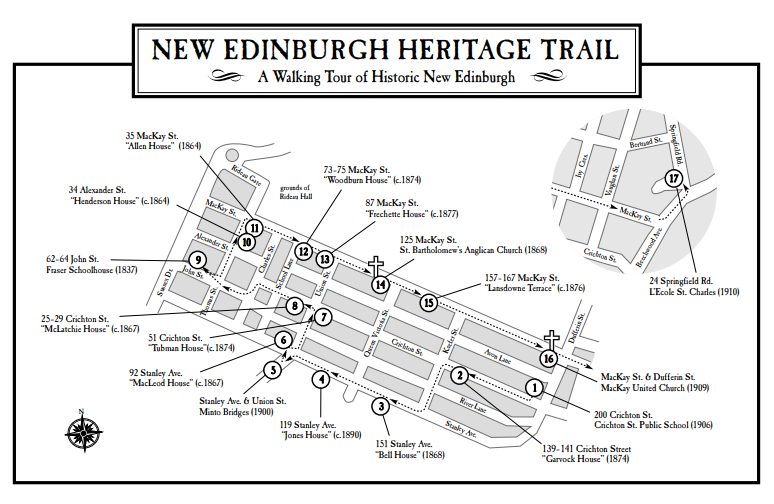
New Edinburgh Heritage Walking Trail

New Edinburgh Heritage Walking Trail Map

In 2008, a heritage walking tour was published in the New Edinburgh News. Based on popular demand, the brochure was updated and published as a brochure — in English and French — highlighting New Edinburgh’s heritage credentials by means of a self-guided walking trail. It connects together all 17 of the individually-designated heritage buildings in the neighbourhood, 16 of which are located within the HCD.

Preparation of the brochure was a major undertaking involving several community volunteers. The photographs were taken by Louise Imbeault, the fine ink sketches were drawn by John Farmer, and the two maps were prepared by Clare Robertson. Translation was undertaken by Anne-Sophie Belzile, production was coordinated by Cindy Parkanyi, and Katherine Arkay worked on sponsorship, distribution, and a whole lot more.

In April 2020, we re-printed the Walking Tour in the New Edinburgh News. For those who missed it, we also offer electronic versions via the links below. Feel free to download and take a stroll through our neighbourhood’s history.